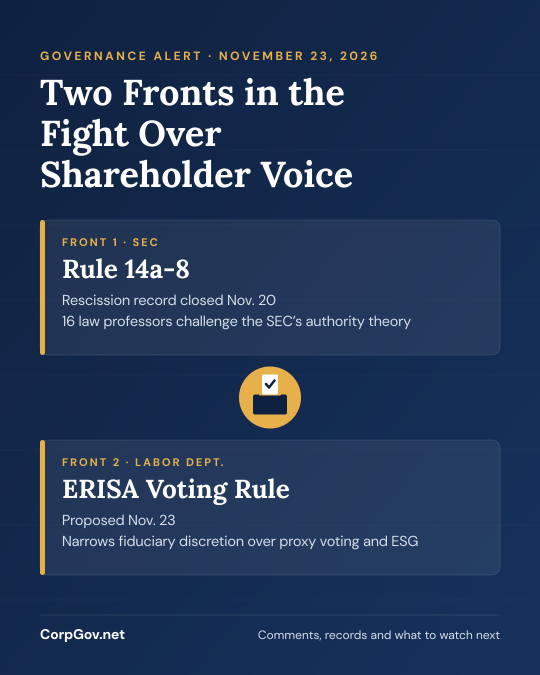
The comment fight over shareholder rights now has two fronts. The SEC’s Rule 14a-8 docket closed November 20. Three days later, the Department of Labor proposed rewriting the ERISA rule that governs how retirement-plan fiduciaries pick investments and vote proxies. Below is what happened this week, what I think it means, and what to say in comments.
1. Labor Department Proposes Narrowing Fiduciary Discretion Over Voting and Engagement
Status: proposed rule. Comments are due 60 days after Federal Register publication.
On November 23, the Department of Labor proposed revising its ERISA investment-duty regulation (DOL fact sheet; rule page and FAQs). The proposal would:
- Require fiduciaries to act for the “exclusive purpose of maximizing the interests” of participants and beneficiaries.
- Remove the 2022 rule’s statement that climate change and other ESG factors may be relevant to risk and return.
- Rescind the “tiebreaker” test, which allowed collateral factors to decide between investments that are otherwise economically equivalent.
- Rescind the provision allowing fiduciaries to consider participant preferences when building a menu of otherwise prudent options.
- Restore the statement that fiduciaries need not vote every proxy or exercise every shareholder right.
The proposal still treats proxy voting and shareholder engagement as fiduciary acts governed by ERISA. DOL says it is acting under Executive Order 14366 of December 11, 2025, “Protecting American Investors from Foreign-Owned and Politically Motivated Proxy Advisors,” which directed the Secretary of Labor to revise these rules and require greater transparency regarding fiduciaries’ use of proxy advisors.
Why It Matters
DOL presents the proposal as a return to neutrality, but the wording could discourage financially motivated stewardship. Diversified retirement investors face risks across the entire portfolio, including climate change, political instability, labor market failures, and systemic financial risk. Those risks often can’t be measured by looking at the expected return of a single security. A rule that tells fiduciaries to focus narrowly on “maximizing” may push them to ignore risks they cannot diversify away.
Saying that not every proxy must be voted on is defensible when the cost of voting truly exceeds the expected benefit. The bigger danger is chilling. Read together with DOL’s April guidance on proxy advisors and the executive order, the rule may lead fiduciaries to see litigation or enforcement risk whenever they support environmental, workforce, or political-spending proposals. Abstention would then become the safe choice even when a vote is clearly warranted.
The rule would cover private-sector ERISA plans, not CalPERS, CalSTRS, or other governmental plans. However, asset managers running pooled funds that hold both ERISA and public-pension money often apply a single voting policy. In practice, an ERISA rule can also set the voting policy for public funds.
What Comments Should Say
- Material climate, workforce, and governance factors are financial considerations, not collateral objectives.
- Diversified, universal owners properly consider effects transmitted through the rest of their portfolios.
- The duty to evaluate whether a vote is worthwhile should not become a presumption against voting.
- Fiduciaries need a workable standard for monitoring proxy advisors, not an expectation that they duplicate the advisors’ research.
- A duty of “maximizing” invites hindsight litigation and is not the same as ERISA’s statutory duties of prudence and loyalty.
Because the proposal responds directly to the executive order, this rulemaking has also become a key venue for defending independent proxy research.
2. Rule 14a-8 Record Closes With Strong Legal and Historical Evidence Against Rescission
Status: comment period closed November 20. No final action yet.
The comment period has closed on the SEC’s proposal to rescind Rule 14a-8 and expand management’s discretionary voting authority under Rule 14a-4 (SEC proposal; comments received). Rule 14a-8 remains in effect. Closing the docket does not change shareholder rights.
Sixteen Law Professors Take on the SEC’s Authority Theory
The most important late filing may be the November 19 letter from 16 corporate and securities law professors, led by Sergio Alberto Gramitto Ricci, Sarah C. Haan, and Christina M. Sautter. The other signers include Jill Fisch, J. Robert Brown Jr., Renée Jones, Donna Nagy, and Cynthia Williams. The letter finds “no basis” for the Commission’s claim that it lacks authority over the rule. Its main arguments are:
- Shareholders made proposals from the meeting floor long before the federal securities laws. Rule 14a-8 restored a right that state law already recognized, but that dispersed ownership had made impractical to use.
- Congress intended Section 14(a) to protect fair corporate suffrage.
- In SEC v. Transamerica, the Third Circuit upheld the rule’s predecessor, stating it entertained “no doubt” that the rule was a proper exercise of the Commission’s authority.
- Combining rescission with broader Rule 14a-4 authority would bring back the blank-proxy abuse Section 14(a) was meant to end, letting management vote proxies against proposals the shareholders granting those proxies never saw described.
This letter will matter in any judicial review. It goes beyond policy preferences to address statutory text, congressional purpose, judicial precedent, past SEC practice, and decades of reliance.
The Management-Side Response, and My Costco Letter
A Gibson Dunn letter filed for more than 30 public companies takes no formal position on rescission itself. Still, it describes Rule 14a-8 as costly, unpredictable, and open to use for unrelated social or political goals. It argues that engagement will continue without the rule. It also asks the SEC to:
- Replace the proposed Rule 14a-4(c) opt-out checkbox with broader discretionary voting authority for management.
- Lower the ten-person exemption for solicitations to two persons when shareholder proposals are involved.
- Expand the definition of “participant” to include anyone who helps draft a proposal or engages with the company.
- Require disclosure of proponent groups (using Schedule 14N as a model), cost-sharing, funders and indirect financial interests.
Footnote 13 quotes my letter to Costco, where I warned that “proponents who lose the 14a-8 route will not simply go away.” Gibson Dunn uses it as evidence that proponents will turn to exempt solicitations and vote-no campaigns. They are right, and that was my point. Losing Rule 14a-8 would not end shareholder advocacy. It would move advocacy into channels that are more adversarial, cost more for everyone, and are aimed at directors rather than at the issue itself.
The letter also recommends that the effective date allow a full proxy season to pass, with earlier effectiveness for companies in states that have amended their laws. That recommendation concedes a central objection to rescission: the promised state-law replacement does not yet exist.
What to Watch
- Whether the SEC reopens the docket or receives significant late comments.
- Whether a final rule includes phased implementation or a temporary federal safe harbor.
- Whether the Commission seriously answers the Transamerica, congressional-ratification and reliance arguments.
- Whether a final rule adds proponent and organizing disclosures that were never developed in the proposal, which could be a notice-and-comment problem.
- How proposals already submitted for the 2027 season are treated.
3. Investors Oppose Removing Exempt Solicitations From EDGAR
Status: comment period closed November 20. Proposal pending.
The separate proxy-modernization docket also closed November 20. The strongest investor objections concern the proposed removal of Notices of Exempt Solicitation (Form PX14A6G) from EDGAR.
In its November 19 comment, ICGN argues that the proposal would leave issuers with full access to the central federal disclosure system while limiting investors’ access. It notes that the SEC already restricted EDGAR access on January 23, 2026 for investors holding less than $5 million of a company’s securities, without providing any alternative channel. ICGN asks the SEC to keep EDGAR access for proposals that appear in company proxy materials, without adding another ownership threshold. It also opposes eliminating minimum delivery periods for proxy statements that incorporate documents by reference, because investors need time to find and analyze information, change voting instructions, and recall loaned shares.
Why It Matters
PX14A6G filings are imperfect, but they create a searchable, company-linked public record of investor advocacy. For retail proponents like me, who have no budget for proxy solicitors, EDGAR is the one place institutional voters reliably look. Eliminating these filings would:
- Make campaign materials harder for shareholders and researchers to find.
- Shift distribution to private mailing lists and commercial platforms.
- Make it harder to monitor for misleading claims from either side.
- Disadvantage small proponents without established media channels.
- Erase evidence that is useful for evaluating stewardship and the history of engagement.
A better approach to modernization would keep centralized filing while clearly labeling voluntary filings, identifying the filer, and distinguishing exempt solicitations from company filings. As ICGN notes, EDGAR already labels filers.
A note of irony: Gibson Dunn wants far more disclosure from proponents, while this proposal would remove the main public venue where proponents disclose. The SEC can’t credibly do both.
4. Executive-Pay Disclosure Comments Due January 19, 2027
Status: proposed rule.
The SEC’s executive-compensation disclosure proposal was published in the Federal Register on November 19, so comments are due January 19, 2027. The proposal would cut named executive officer disclosure to the CEO and CFO. It would also simplify perquisite disclosure, pay-ratio reporting and pay-versus-performance reporting, and revise the Compensation Discussion and Analysis.
Investor comments should focus on the information actually used in say-on-pay votes and in evaluating compensation committees. That includes comparable disclosure for other highly paid executives, a pay ratio that reflects the global and part-time workforce, and executive perquisites, which often reveal weak board oversight long before anything else does.
Pending Without Material Change
The public docket still shows no ruling following the October 29 hearing on the SEC’s effort to compel ISS to produce client-linked recommendation and voting information. The SEC continues to call the inquiry fact-finding and has announced no violation (SEC litigation release).
Bottom Line
The immediate advocacy priority has moved from Rule 14a-8 to the Labor Department’s fiduciary proposal. The strongest response will defend financially grounded stewardship, including universal-owner analysis, while accepting that fiduciaries need not cast votes that truly cost more than they are worth. Meanwhile, the closed Rule 14a-8 record holds substantial material for an administrative-law challenge. It includes many strong arguments and evidence, including those from corporate-law scholars and a management-side letter conceding that the state-law alternative isn’t ready.
Collaborate with CorpGov.net on Social Media (or Leave Comments at the bottom)
Linkedin
BlueSky
Facebook
Mastodon
Substack
X (formerly Twitter)
Related Posts
AI Proxy Voting, Incidental Humans, and the Case for Rule 14a-8
No comments yet.